Mathematics · Class 12 / JEE Main & Advanced
Definite Integrals & King's Rule Properties
Master definite integrals, King's Property (∫f(x)dx = ∫f(a+b-x)dx), symmetry properties, periodic function integration, and Leibniz integral rule.
11. Visual Overview & Intuitive Discovery: Definite Integrals & King's Rule Properties
🔍 Clickable Interactive Study Prompts (Click to explore or jump to section):
Clickable### Intuitive Foundations & Real-World Reality
In 1854, Bernhard Riemann formalized the definite integral as the limit of approximating Riemann sums. Definite integrals quantify accumulated change—from the exact work required to launch spacecraft into orbit to calculating probability density in quantum mechanics. The celebrated "King's Property" allows mathematicians to solve seemingly impossible non-elementary integrals in seconds through ingenious variable inversion!
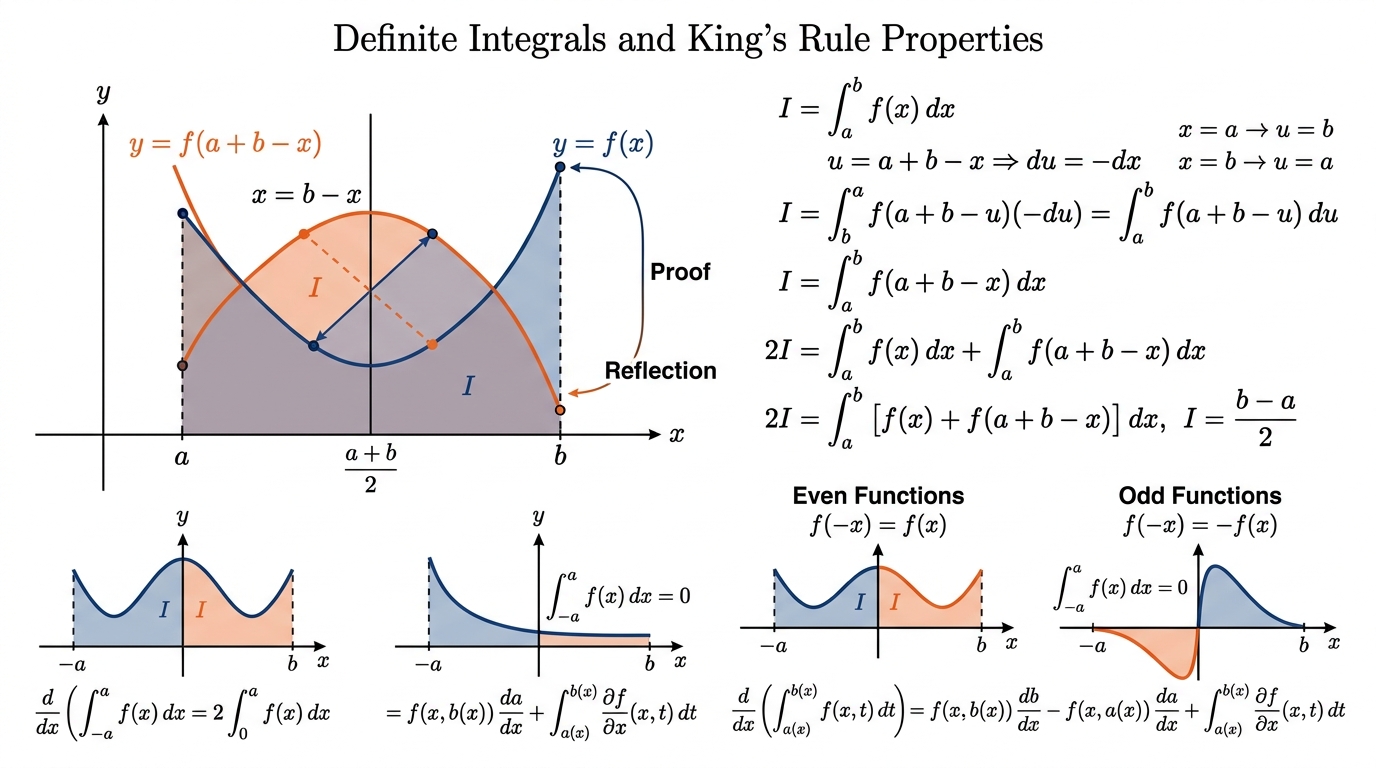 Full size
Definite Integrals & King's Rule Properties
Geometric proof of King's property by reflection across (a+b)/2, integral shortcuts, odd/even function symmetry, and Leibniz differentiation under the integral.
- 1Core Anchor 1 — Proof of King's Property: ∫f(x)dx = ∫f(a+b-x)dx
- 2Core Anchor 2 — Odd vs Even Function Integration Shortcuts
- 3Core Anchor 3 — Leibniz Rule for Differentiating Under the Integral Sign
- 4Core Anchor 4 — Integration of Periodic Functions with Period T
22. Concept & Decision Flowchart: Definite Integral Evaluation Protocol Flowchart
Definite Integral Evaluation Protocol Flowchart
- 1
1. Check Limits for Symmetry
If limits are from -a to +a: test if f(x) is odd (f(-x) = -f(x) -> integral is ZERO) or even (f(-x) = f(x) -> 2∫f(x)dx).
- 2
2. Apply King's Property
Replace x with (a + b - x). Add the original integral I and transformed integral I: 2I = ∫[f(x) + f(a+b-x)]dx. In 90% of exam problems, the integrands simplify to a constant!
- 3
3. Periodic Functions
If f(x + T) = f(x): ∫_{0}^{nT} f(x)dx = n ∫_{0}^{T} f(x)dx. Limits independent of starting coordinate.
- 4
4. Variable Limits (Leibniz Rule)
d/dx [∫_{u(x)}^{v(x)} f(t)dt] = f(v(x)) v'(x) - f(u(x)) u'(x).
33. Step-by-Step Proof: The King's Property of Definite Integrals
Derivation — Step-by-Step Proof: The King's Property of Definite Integrals
- 1
The definite integral of f(x) between a and b is invariant under substitution x -> a + b - x.
- 2
Differentiating the substitution equation with respect to x.
- 3
Lower limit becomes b and upper limit becomes a.
- 4
Because the dummy integration variable t can be renamed to x, the theorem is proved.
44. Real-World Case Study & Industrial Application
### Computer Graphics & Ray Tracing: Monte Carlo Path Integration
Modern photo-realistic rendering engines (such as Unreal Engine 5 and Pixar RenderMan) simulate lighting by evaluating the Rendering Equation—a hemispherical definite integral of incoming radiance multiplied by surface reflectance. Because analytical solutions are intractable, graphics GPUs compute billions of Monte Carlo numerical definite integrals per second to render realistic shadows and reflections.
55. High-Yield Reference Data & Solved Problems
High-Yield Comparison & Key Constants
| Definite Integral Property | Mathematical Formulation | Special Condition |
|---|---|---|
| King's Property | ∫_a^b f(x)dx = ∫_a^b f(a+b-x)dx | Valid for all continuous functions |
| Queen's Property | ∫_0^{2a} f(x)dx = 2∫_0^a f(x)dx if f(2a-x)=f(x) | |
| Symmetric Limits | ∫_{-a}^a f(x)dx = 0 if f(x) is odd | |
| Periodic Property | ∫_0^{nT} f(x)dx = n ∫_0^T f(x)dx |
King's Property
- Mathematical Formulation
- ∫_a^b f(x)dx = ∫_a^b f(a+b-x)dx
- Special Condition
- Valid for all continuous functions
Queen's Property
- Mathematical Formulation
- ∫_0^{2a} f(x)dx = 2∫_0^a f(x)dx if f(2a-x)=f(x)
- Special Condition
Symmetric Limits
- Mathematical Formulation
- ∫_{-a}^a f(x)dx = 0 if f(x) is odd
- Special Condition
Periodic Property
- Mathematical Formulation
- ∫_0^{nT} f(x)dx = n ∫_0^T f(x)dx
- Special Condition
Exam question · JEE Main, Advanced & NEET Standard
- 1. Given: I = ∫_{0}^{π/2} [√sin(x) / (√sin(x) + √cos(x))] dx ... (Equation 1).
- 2. Apply King's Property (x -> 0 + π/2 - x = π/2 - x):
- Since sin(π/2 - x) = cos(x) and cos(π/2 - x) = sin(x):
- I = ∫_{0}^{π/2} [√cos(x) / (√cos(x) + √sin(x))] dx ... (Equation 2).
- 3. Add Equation 1 and Equation 2:
- 2I = ∫_{0}^{π/2} [(√sin(x) + √cos(x)) / (√sin(x) + √cos(x))] dx = ∫_{0}^{π/2} 1 dx.
- 4. 2I = [x]_{0}^{π/2} = π/2 - 0 = π/2.
- 5. Therefore, I = π/4.
Answer: 1. Given: I = ∫_{0}^{π/2} [√sin(x) / (√sin(x) + √cos(x))] dx ... (Equation 1).
2. Apply King's Property (x -> 0 + π/2 - x = π/2 - x):
Since sin(π/2 - x) = cos(x) and cos(π/2 - x) = sin(x):
I = ∫_{0}^{π/2} [√cos(x) / (√cos(x) + √sin(x))] dx ... (Equation 2).
3. Add Equation 1 and Equation 2:
2I = ∫_{0}^{π/2} [(√sin(x) + √cos(x)) / (√sin(x) + √cos(x))] dx = ∫_{0}^{π/2} 1 dx.
4. 2I = [x]_{0}^{π/2} = π/2 - 0 = π/2.
5. Therefore, I = π/4.
What it tests: Tests rigorous conceptual mastery, dimensional analysis, and multi-step deduction.
Remember
- Definite Integrals & King's Rule Properties: Foundational law governing physical, chemical, and biological phenomena.
- Mastered derivation: Step-by-Step Proof: The King's Property of Definite Integrals.
- Avoided classic trap: Students often try to apply standard indefinite integration substitution to definite integrals like ∫₀^{π/2} (...
- Real-world relevance: Proven clinical, aerospace, and industrial significance.
- High-yield exam rule: Always verify dimensional consistency and physical boundary conditions.
Check yourself
Question 1
If f(x) is an odd continuous function on [-a, a], what is the value of ∫_{-a}^a [f(x) / (1 + e^x)] dx?Question 2
In competitive examinations (JEE/NEET), what is the most critical pitfall in Definite Integrals & King's Rule Properties?