Mathematics · AP Calculus · College Level
Derivatives and the Chain Rule
TheChain Ruleis the fundamental differentiation technique in calculus used to compute the derivative of acomposite function, multiplying the derivative of the outer function by the derivative of the inner function.
1What is the Chain Rule? Visual Overview
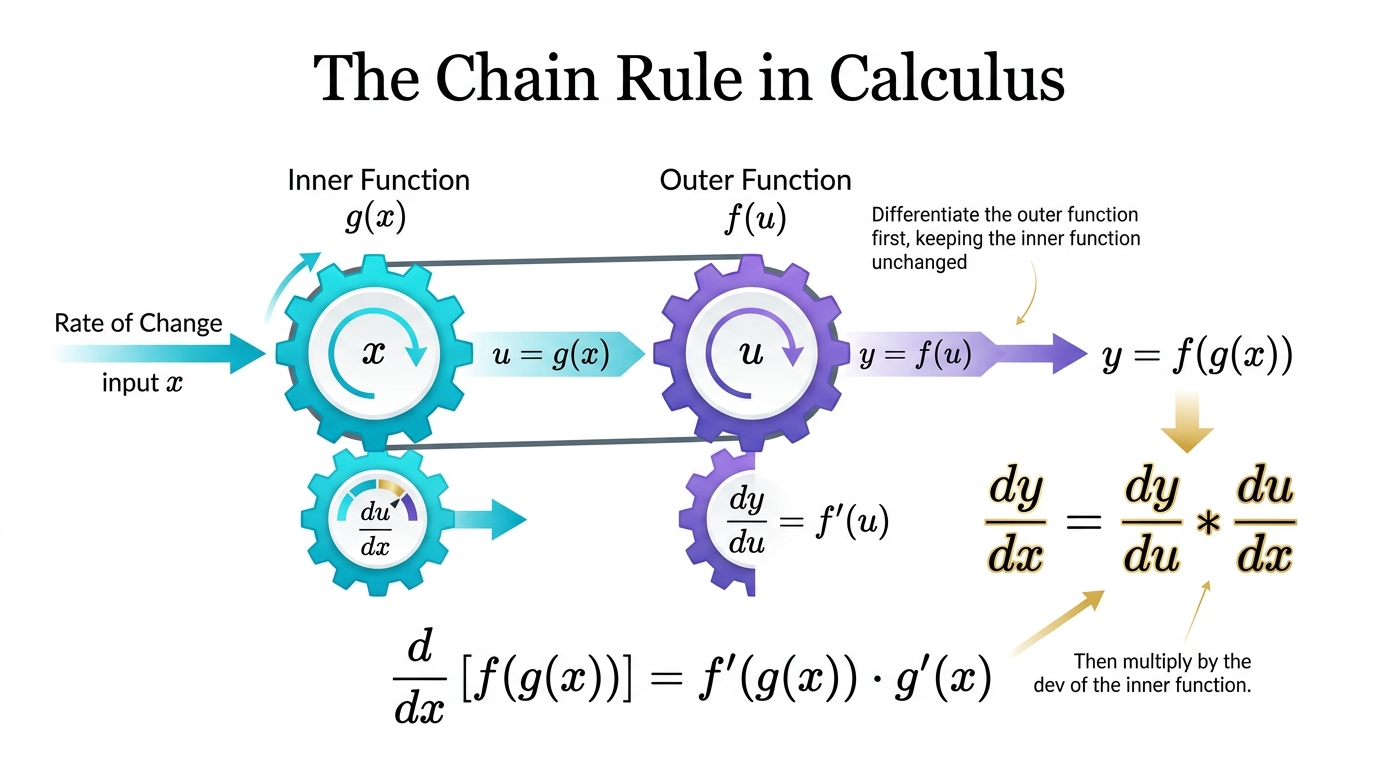
In calculus, simple formulas like the power rule only work when the base is simply . When an expression is "nested" inside another function—such as or —we must apply theChain Rule. Think of it as coupled gears transmitting rates of change.
 Full size
The Chain Rule: Rate of Change Transmission
Think of composite functions as coupled gears: the rate of change of y with respect to x equals the rate of change of y relative to u multiplied by the rate of change of u relative to x.
- 1Input x — The base independent variable driving the system
- 2Inner Function g(x) — Transforms input x into intermediate variable u = g(x)
- 3Inner Rate du/dx — How fast the intermediate value u changes as x moves
- 4Outer Function f(u) — Operates on u to produce the final output y = f(u)
- 5Outer Rate dy/du — Differentiates the outer structure while holding the inside frozen
- 6Chain Multiplier — Multiplying the two rates yields dy/dx = (dy/du) * (du/dx)
Definition
Composite Function — A function where the output of an inner function serves as the input to an outer function .
The Chain Rule (Function Notation)
- f(g(x)) = The composite function
- f'(g(x)) = Derivative of outer function evaluated at unchanged inner function
- g'(x) = Derivative of the inner function
The Chain Rule (Leibniz Notation)
- y = Outer dependent variable ($y = f(u)$)
- u = Intermediate inner variable ($u = g(x)$)
- x = Independent input variable
24-Step Algorithm & Worked Examples
4-Step Algorithm to Differentiate Any Composite Function
- 1
1. Identify Layers
Isolate the outer shell f(u) and the inner expression u = g(x)
- 2
2. Differentiate Outer
Take derivative of f, leaving the inner argument completely untouched
- 3
3. Differentiate Inner
Compute g'(x) separately on scrap paper
- 4
4. Multiply & Simplify
Multiply outer result by g'(x) and simplify algebraic factors
Real-life example · Example 1: General Power Rule
Differentiate .
• Step 1: Let inner , outer .
• Step 2: .
• Step 3: .
• Step 4: .
Real-life example · Example 2: Trigonometric Composite
Differentiate .
• Outer is , so derivative is .
• Inner is , derivative is .
• Result: .
3Common Derivative Patterns & Traps
Common Standard Chain Rule Patterns
| Function Type | Composite Formula y | Derivative dy/dx | Quick Example |
|---|---|---|---|
| Power Chain | |||
| Exponential | |||
| Natural Log | |||
| Trig (Sine) |
Power Chain
- Composite Formula y
- Derivative dy/dx
- Quick Example
Exponential
- Composite Formula y
- Derivative dy/dx
- Quick Example
Natural Log
- Composite Formula y
- Derivative dy/dx
- Quick Example
Trig (Sine)
- Composite Formula y
- Derivative dy/dx
- Quick Example
4Exam-Style AP Question
Exam question · AP Calculus AB / BC
- A.-20
- B.15
- C.-12
- D.1
- 1. Apply the chain rule: .
- 2. Substitute : .
- 3. We know , so .
- 4. Therefore, .
Answer: A. -20
What it tests: Direct substitution into the chain rule formula .
Remember
- The chain rule is required whenever a function has another function nested inside it.
- Core formula: .
- Never differentiate the inner function inside the outer function — differentiate the outer shell first, keeping the inner argument intact, then multiply by the inner derivative.
- In Leibniz notation: .
- For nested compositions , apply the chain rule iteratively from outside to innermost.
Check yourself
Question 1
What is the derivative of with respect to ?Question 2
Find .Question 3
Differentiate .Question 4
If , what is ?