Chemistry · Class 12 / JEE & NEET
Electrochemistry: Nernst Equation & Galvanic Cells
Master Galvanic Cells, standard electrode potentials, Nernst equation derivation, Kohlrausch law, and battery thermodynamics.
11. Visual Overview & Intuitive Discovery: Electrochemistry: Nernst Equation & Galvanic Cells
🔍 Clickable Interactive Study Prompts (Click to explore or jump to section):
Clickable### Intuitive Foundations & Real-World Reality
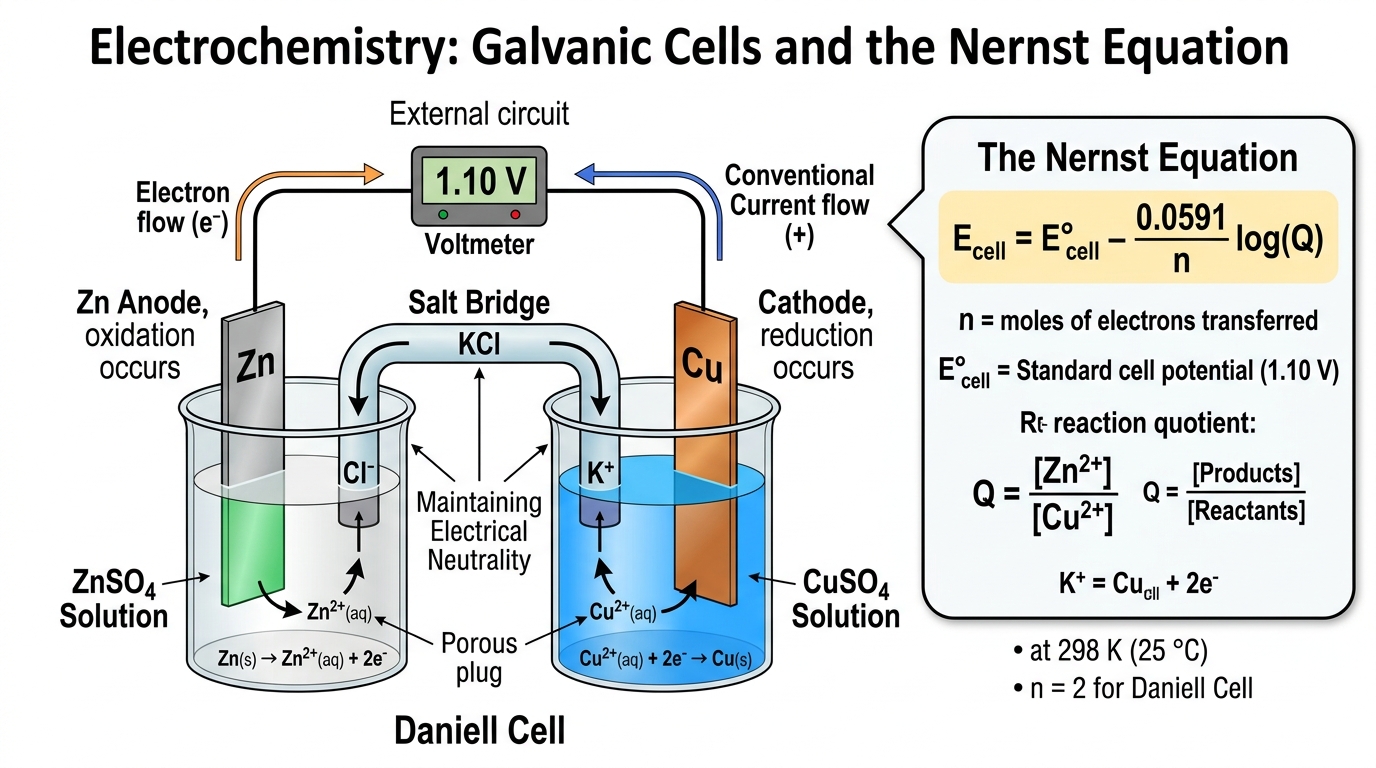
In 1889, German chemist Walther Nernst unified chemical thermodynamics with electrochemistry. He connected the work done by moving electrons in a circuit to the change in Gibbs free energy (ΔG = -nFE). By applying the reaction quotient Q, Nernst showed that cell voltage is not static: as chemical concentrations shift, voltage drops continuously until equilibrium is reached, where cell potential becomes exactly zero and the battery dies!
 Full size
Galvanic Cells, Daniell Cell & Nernst Equation
Daniell cell architecture with Zn anode and Cu cathode, KCl salt bridge neutrality, electron flow vs current, and Nernst equation calculations.
- 1Core Anchor 1 — Derive the Nernst Equation from Gibbs Free Energy
- 2Core Anchor 2 — Kohlrausch Law of Independent Migration
- 3Core Anchor 3 — Electrochemical Series & Predicting Feasibility
- 4Core Anchor 4 — Lead-Acid Battery & Hydrogen Fuel Cell Chemistry
22. Concept & Decision Flowchart: Galvanic Cell EMF Calculation Flowchart
Galvanic Cell EMF Calculation Flowchart
- 1
1. Identify Anode & Cathode
Anode = Oxidation (An Ox: electrons released, lower standard reduction potential). Cathode = Reduction (Red Cat: electrons consumed).
- 2
2. Calculate Standard EMF (E°cell)
E°cell = E°cathode - E°anode (both expressed as standard reduction potentials).
- 3
3. Formulate Reaction Quotient (Q)
Write the balanced redox equation: Q = [Products]^p / [Reactants]^r (pure solids/liquids have activity = 1).
- 4
4. Apply Nernst Equation at 298 K
E_cell = E°cell - (0.0591 / n) log10(Q). When E_cell > 0, the reaction is spontaneous.
33. Step-by-Step Derivation of the Nernst Equation
Derivation — Step-by-Step Derivation of the Nernst Equation
- 1
From chemical thermodynamics, free energy change at non-standard state is related to standard free energy ΔG° and quotient Q.
- 2
n is moles of electrons transferred, F is Faraday constant (96,485 C/mol), and E is cell electromotive force.
- 3
Dividing both sides by -nF isolates the cell potential.
- 4
This simplified formula allows instant calculation of cell voltages under arbitrary ionic concentrations.
44. Real-World Case Study & Industrial Application
### Industrial Technology: Lithium-Ion Battery Degradation
Modern electric vehicles utilize lithium-ion cells with graphite anodes and LiCoO2/NMC cathodes. According to the Nernst equation, as lithium ions de-intercalate during discharge, the chemical activity ratio changes, leading to the smooth voltage curve from 4.2V down to 3.0V. Battery Management Systems (BMS) continuously compute the Nernst potential to accurately gauge State of Charge (SoC).
55. High-Yield Reference Data & Solved Problems
High-Yield Comparison & Key Constants
| Electrode Reaction | Standard Potential E° (V) | Behavior | Common Application |
|---|---|---|---|
| Li⁺ + e⁻ -> Li(s) | -3.05 V | Strongest reducing agent | Lithium batteries |
| Zn²⁺ + 2e⁻ -> Zn(s) | -0.76 V | Oxidizes readily (Anode in Daniell cell) | Galvanization of steel |
| 2H⁺ + 2e⁻ -> H2(g) | 0.00 V | Universal Reference (SHE) | Electrode potential baseline |
| Cu²⁺ + 2e⁻ -> Cu(s) | +0.34 V | Easily reduced (Cathode in Daniell cell) | Daniell cell cathode |
| F2(g) + 2e⁻ -> 2F⁻ | +2.87 V | Strongest oxidizing agent | Industrial fluorination |
Li⁺ + e⁻ -> Li(s)
- Standard Potential E° (V)
- -3.05 V
- Behavior
- Strongest reducing agent
- Common Application
- Lithium batteries
Zn²⁺ + 2e⁻ -> Zn(s)
- Standard Potential E° (V)
- -0.76 V
- Behavior
- Oxidizes readily (Anode in Daniell cell)
- Common Application
- Galvanization of steel
2H⁺ + 2e⁻ -> H2(g)
- Standard Potential E° (V)
- 0.00 V
- Behavior
- Universal Reference (SHE)
- Common Application
- Electrode potential baseline
Cu²⁺ + 2e⁻ -> Cu(s)
- Standard Potential E° (V)
- +0.34 V
- Behavior
- Easily reduced (Cathode in Daniell cell)
- Common Application
- Daniell cell cathode
F2(g) + 2e⁻ -> 2F⁻
- Standard Potential E° (V)
- +2.87 V
- Behavior
- Strongest oxidizing agent
- Common Application
- Industrial fluorination
Exam question · JEE Main, Advanced & NEET Standard
- 1. Standard cell potential E°cell = E°cathode - E°anode = 0.34 - (-0.76) = +1.10 V.
- 2. Overall cell reaction: Zn(s) + Cu²⁺(aq) -> Zn²⁺(aq) + Cu(s). Number of electrons transferred n = 2.
- 3. Reaction quotient Q = [Zn²⁺] / [Cu²⁺] = 0.1 / 0.01 = 10.
- 4. Apply Nernst equation: E_cell = 1.10 - (0.0591 / 2) log10(10) = 1.10 - 0.02955(1) = 1.07045 V ≈ 1.07 V.
Answer: 1. Standard cell potential E°cell = E°cathode - E°anode = 0.34 - (-0.76) = +1.10 V.
2. Overall cell reaction: Zn(s) + Cu²⁺(aq) -> Zn²⁺(aq) + Cu(s). Number of electrons transferred n =
2. 3. Reaction quotient Q = [Zn²⁺] / [Cu²⁺] = 0.1 / 0.01 =
10. 4. Apply Nernst equation: E_cell = 1.10 - (0.0591 / 2) log10(10) = 1.10 - 0.02955(1) = 1.07045 V ≈ 1.07 V.
What it tests: Tests rigorous conceptual mastery, dimensional analysis, and multi-step deduction.
Remember
- Electrochemistry: Nernst Equation & Galvanic Cells: Foundational law governing physical, chemical, and biological phenomena.
- Mastered derivation: Step-by-Step Derivation of the Nernst Equation.
- Avoided classic trap: Students often multiply the standard electrode potential E° by stoichiometric coefficients when balancing redo...
- Real-world relevance: Proven clinical, aerospace, and industrial significance.
- High-yield exam rule: Always verify dimensional consistency and physical boundary conditions.
Check yourself
Question 1
At chemical equilibrium, what is the value of E_cell and ΔG for a galvanic cell?Question 2
In competitive examinations (JEE/NEET), what is the most critical pitfall in Electrochemistry: Nernst Equation & Galvanic Cells?