Chemistry · Class 12 / JEE & NEET
Haloalkanes & Haloarenes: SN1 vs SN2 Mechanisms
Master nucleophilic substitution: SN1 carbocation stability vs SN2 backside attack, Walden inversion, stereochemistry, and low reactivity of haloarenes.
11. Visual Overview & Intuitive Discovery: Haloalkanes & Haloarenes: SN1 vs SN2 Mechanisms
🔍 Clickable Interactive Study Prompts (Click to explore or jump to section):
Clickable### Intuitive Foundations & Real-World Reality
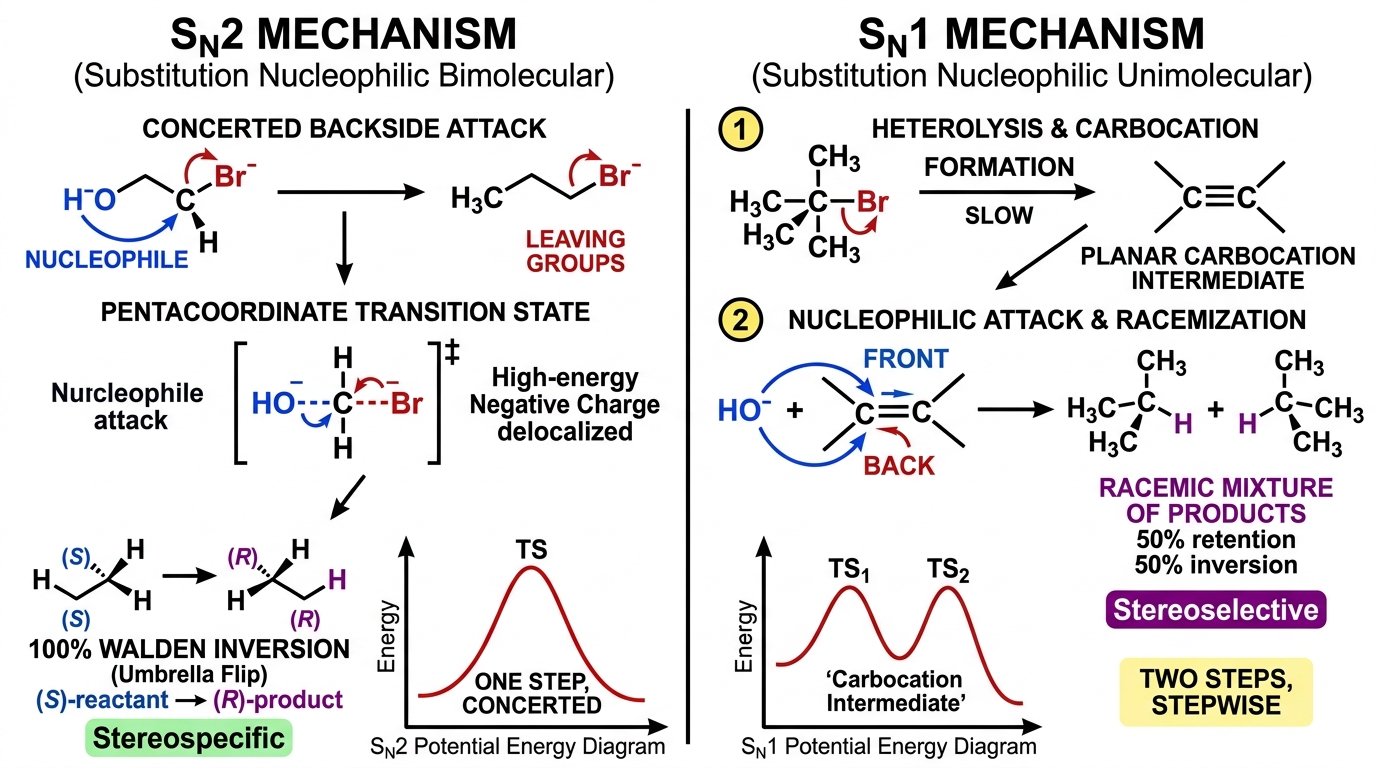
In 1896, Paul Walden observed that when (-)-malic acid was converted to (+)-chlorosuccinic acid with PCl5, its optical rotation flipped sign. This mysterious optical inversion—now known as Walden Inversion—was solved when Hughes and Ingold proved that in bimolecular nucleophilic substitution (SN2), the nucleophile attacks from 180° opposite the leaving group, turning the tetrahedral carbon inside-out like an umbrella in a gale!
 Full size
SN1 vs SN2 Mechanisms & Stereochemistry
Concerted backside attack with 100% Walden inversion for SN2 vs two-step carbocation heterolysis with racemization for SN1, and reaction energy coordinates.
- 1Core Anchor 1 — SN1 vs SN2 Energy Profiles & Reaction Kinetics
- 2Core Anchor 2 — Walden Inversion Stereochemistry in SN2
- 3Core Anchor 3 — Elimination vs Substitution (Saytzeff vs Hofmann Rule)
- 4Core Anchor 4 — Low Reactivity of Haloarenes due to Resonance
22. Concept & Decision Flowchart: SN1 vs SN2 Reaction Mechanism Decision Flowchart
SN1 vs SN2 Reaction Mechanism Decision Flowchart
- 1
1. Substrate Structure
Tertiary (3°) halide -> SN1 (forms stable tertiary carbocation). Primary (1°) / Methyl -> SN2 (minimal steric hindrance).
- 2
2. Nucleophile Strength
Strong, concentrated nucleophile (OH⁻, CN⁻, I⁻) favors SN2. Weak neutral nucleophile (H2O, ROH) favors SN1.
- 3
3. Solvent Effect
Polar protic solvents (H2O, EtOH) stabilize carbocations -> favors SN1. Polar aprotic solvents (DMSO, DMF, acetone) leave nucleophiles naked -> favors SN2.
- 4
4. Stereochemical Outcome
SN1 gives Racemization with partial inversion (planar intermediate). SN2 gives complete 100% Inversion of configuration.
33. Step-by-Step Derivation & Kinetics: SN1 vs SN2 Rate Laws
Derivation — Step-by-Step Derivation & Kinetics: SN1 vs SN2 Rate Laws
- 1
Both alkyl halide and nucleophile participate in the single rate-determining transition state with pentacoordinate carbon.
- 2
First step is slow, reversible carbocation formation. Nucleophile concentration does not affect the rate.
- 3
Because sp² hybridized carbocation is flat, nucleophile attacks from either face with roughly equal probability.
- 4
100% Walden inversion occurs at the chiral center without any retention of configuration.
44. Real-World Case Study & Industrial Application
### Pharmaceutical Synthesis: Enantiopure Drug Manufacturing
In chiral drug manufacturing (such as non-steroidal anti-inflammatory drugs like (S)-Ibuprofen), SN2 reactions are used because of their strict stereospecificity. Choosing polar aprotic solvents like DMF prevents carbocation rearrangements and guarantees >99% enantiomeric excess, avoiding harmful enantiomers like the tragic thalidomide disaster.
55. High-Yield Reference Data & Solved Problems
High-Yield Comparison & Key Constants
| Feature | SN1 Mechanism | SN2 Mechanism |
|---|---|---|
| Kinetics | First order: Rate = k[RX] | Second order: Rate = k[RX][Nu⁻] |
| Number of Steps | Two steps (Carbocation intermediate) | One concerted step (Transition state) |
| Substrate Reactivity | 3° > 2° > 1° > CH3-X | CH3-X > 1° > 2° > 3° |
| Preferred Solvent | Polar Protic (H2O, EtOH) | Polar Aprotic (Acetone, DMSO) |
| Stereochemistry | Racemization with partial inversion | 100% Walden Inversion |
Kinetics
- SN1 Mechanism
- First order: Rate = k[RX]
- SN2 Mechanism
- Second order: Rate = k[RX][Nu⁻]
Number of Steps
- SN1 Mechanism
- Two steps (Carbocation intermediate)
- SN2 Mechanism
- One concerted step (Transition state)
Substrate Reactivity
- SN1 Mechanism
- 3° > 2° > 1° > CH3-X
- SN2 Mechanism
- CH3-X > 1° > 2° > 3°
Preferred Solvent
- SN1 Mechanism
- Polar Protic (H2O, EtOH)
- SN2 Mechanism
- Polar Aprotic (Acetone, DMSO)
Stereochemistry
- SN1 Mechanism
- Racemization with partial inversion
- SN2 Mechanism
- 100% Walden Inversion
Exam question · JEE Main, Advanced & NEET Standard
- 1. 1-bromobutane is a primary (1°) halide with minimal sterics, reacting with strong base/nucleophile NaOEt via SN2 to yield ethyl butyl ether (CH3CH2CH2CH2-O-CH2CH3) as the major product (Williamson Ether Synthesis).
- 2. 2-bromo-2-methylpropane is a tertiary (3°) halide. Because sterics block backside nucleophilic attack and ethoxide is a strong base, it undergoes E2 elimination rather than substitution, yielding 2-methylpropene (isobutylene, (CH3)2C=CH2) as the dominant product (>95%).
Answer: 1. 1-bromobutane is a primary (1°) halide with minimal sterics, reacting with strong base/nucleophile NaOEt via SN2 to yield ethyl butyl ether (CH3CH2CH2CH2-O-CH2CH3) as the major product (Williamson Ether Synthesis).
2. 2-bromo-2-methylpropane is a tertiary (3°) halide. Because sterics block backside nucleophilic attack and ethoxide is a strong base, it undergoes E2 elimination rather than substitution, yielding 2-methylpropene (isobutylene, (CH3)2C=CH2) as the dominant product (>95%).
What it tests: Tests rigorous conceptual mastery, dimensional analysis, and multi-step deduction.
Remember
- Haloalkanes & Haloarenes: SN1 vs SN2 Mechanisms: Foundational law governing physical, chemical, and biological phenomena.
- Mastered derivation: Step-by-Step Derivation & Kinetics: SN1 vs SN2 Rate Laws.
- Avoided classic trap: Students often assume SN1 yields a 50:50 exact racemic mixture. In reality, the leaving group X⁻ hovers near t...
- Real-world relevance: Proven clinical, aerospace, and industrial significance.
- High-yield exam rule: Always verify dimensional consistency and physical boundary conditions.
Check yourself
Question 1
Why are haloarenes (e.g., chlorobenzene) extremely unreactive towards nucleophilic substitution compared to haloalkanes?Question 2
In competitive examinations (JEE/NEET), what is the most critical pitfall in Haloalkanes & Haloarenes: SN1 vs SN2 Mechanisms?